research
Molecular Machines
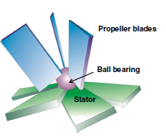
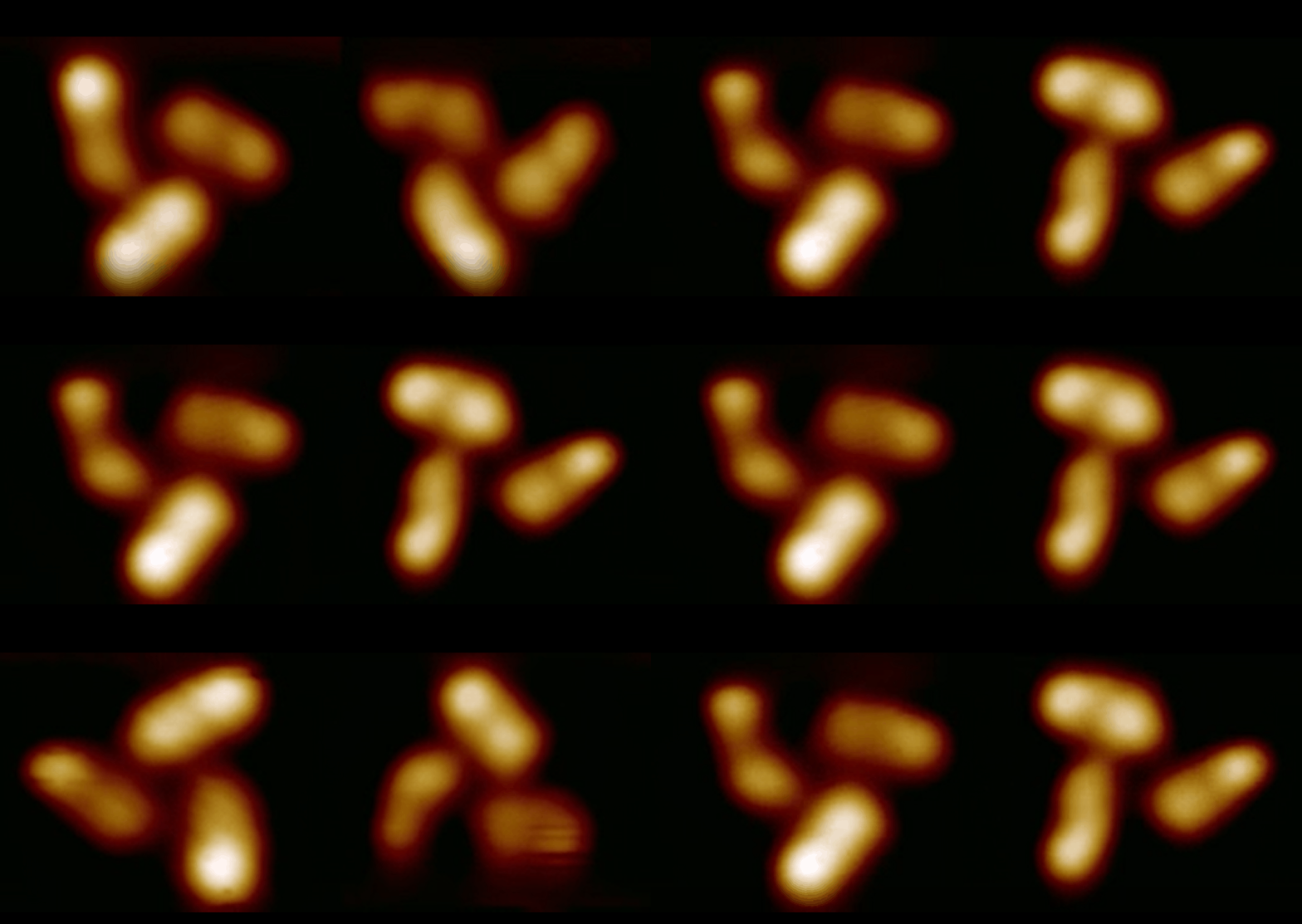
The significance of miniaturizing machines found in the macroscopic world and developing functional nanomachines is evident from the 2016 Chemistry Nobel Prize. We collaborate with chemists in artificial molecular machine design and synthesis. In contrast to investigating ensemble behavior of molecular machines in solution phase, SPM is utilized to operate individual molecular machines in solid platforms at the single molecule level, and motions of nanomachines are systematically controlled.
Nanomachines under investigation include, but are not limited to, single molecule motors, unidirectional propellers, rotor networks, and molecular transport devices on surfaces.
Mechanical Laws at Nanoscale
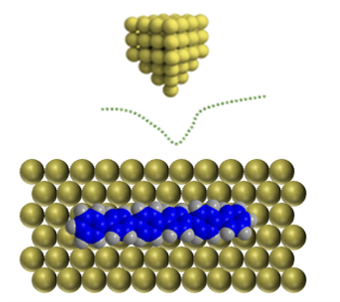
Historically, it is believed that macroscopic mechanical laws do not generally apply in nanoscale contacts. In our research group, by combining qPlus atomic force microscopy (Q+AFM) and scanning tunneling microscopy (STM), we quantify forces involved in molecular motions at the piconewton level and investigate mechanical rules governing molecules in motion on surfaces.
Our research reveals that there is a continuum between macroscopic and nanoscale laws of motion to some extent, while also indicating vast distinctions. We work on understanding fundamental laws of motion at the nanoscale more comprehensively. Such precise measurement at the single molecule level cannot be achieved without combining AFM with STM.
AFM with a high Q factor senses subtle tip-molecule/material interactions, while STM enables precise manipulation of molecules at the angstrom scale.
Material Science
Various 2D materials and molecular systems are fabricated in situ and characterized by local spectroscopy of STM/Q+AFM in search of novel electrical, magnetic, and mechanical properties. The capability of local chemistry alteration allows direct engineering of material properties at the atomic scale.
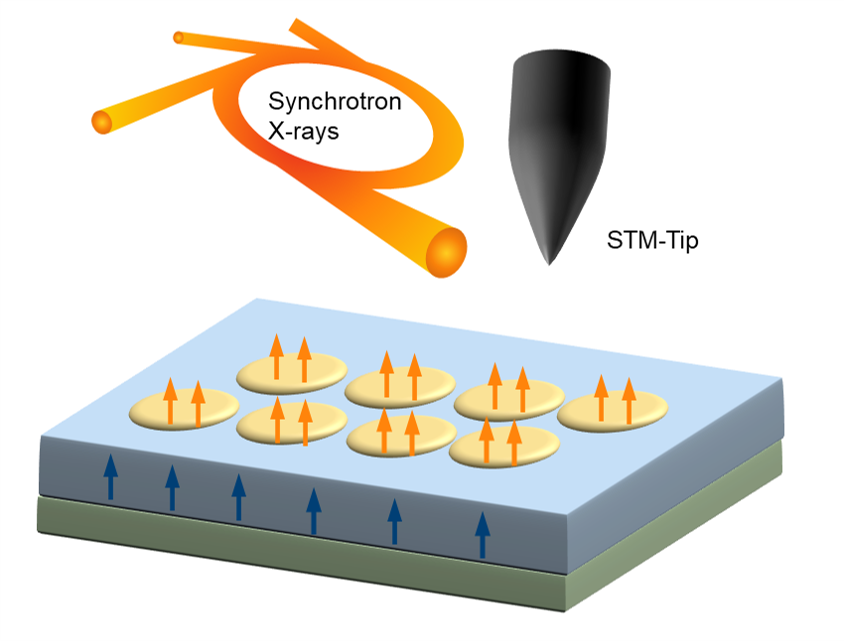
By combining synchrotron radiation with traditional STM, we study magnetization and charge transfer phenomena of materials, molecular complexes, and buried interfaces. Magnetic contrast provided by synchrotron x-rays and the high spatial resolution of STM offer localized x-ray circular dichroism (STM-XMCD).
Physical Chemistry
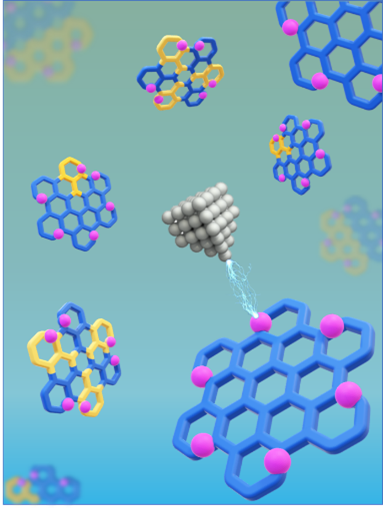
We construct supramolecules with diameters on the order of 20 nm via intra- and intermolecular coordination-driven self-assembly. Characterization at submolecular resolution by STM and scanning tunneling spectroscopy enables unambiguous atomic-scale determination of individual isomers. Statistics of isomer distributions are used to evaluate kinetic and thermodynamic control involved in the self-assembly process.
Exploring the structure-property relationship of polymers remains challenging due to the variability and low atomic resolution of amorphous single polymer chains. We develop a mark-up strategy to directly visualize single polymer chains and enhance characterization of polymers at the single-molecule level.